SPDBV TUTORIAL FREE DOWNLOAD
Molecule may be saved in the exact orientation it appears on screen by choosing the "Save PDB" item of the "File" menu. In addition to its many built in features, it is tightly linked to Swiss-Model http: Fragments coming from different molecules may be merged to build a new entity. This is done by selecting in each layer the groups that will appear in a new layer, and then use the "Create Merged Layer" item of the Edit Menu. Double-click on the Swiss-PdbViewer icon to start the program. The narrow "Align" window appears below the graphics window, showing the amino-acid sequence of the protein in one-letter abbreviations. 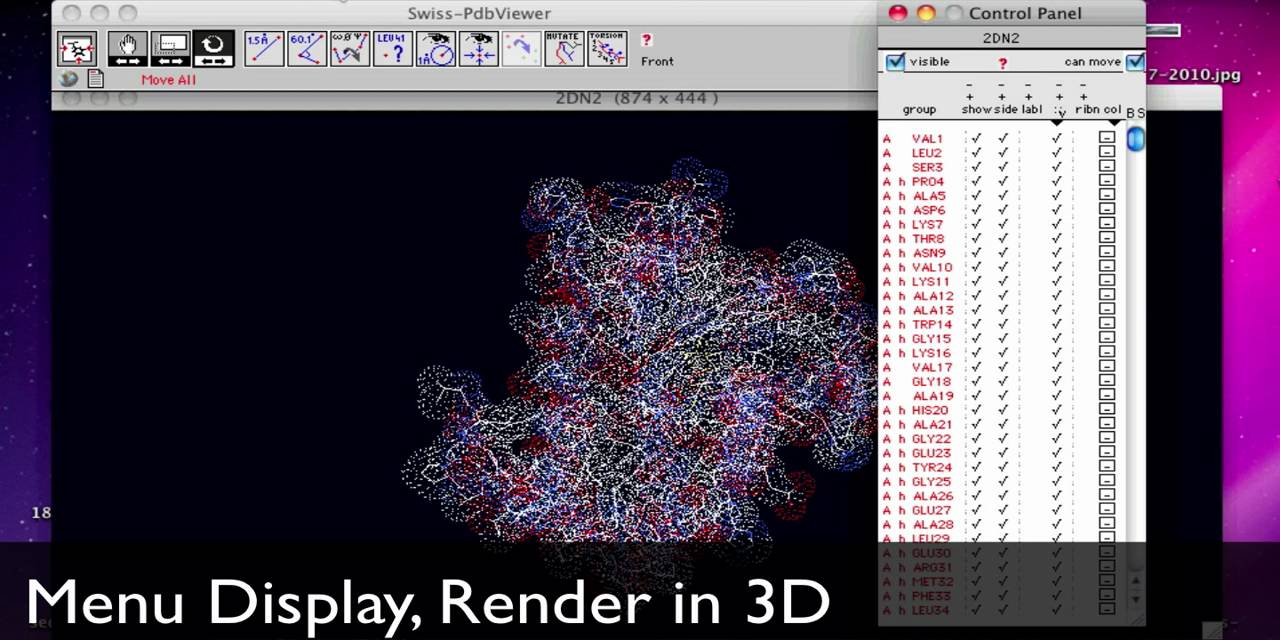
| Uploader: | Talkis |
| Date Added: | 27 November 2006 |
| File Size: | 62.1 Mb |
| Operating Systems: | Windows NT/2000/XP/2003/2003/7/8/10 MacOS 10/X |
| Downloads: | 99688 |
| Price: | Free* [*Free Regsitration Required] |

Below the first tool button Window Attributesthere are two symbols, a globe or protein icon and paper icon. The "merged" molecule will appear in a new layer, which can be renamed using the "Rename Current Layer" item of the "Edit Menu". Another two small icons.
The Ramachandran Plot window may also be used to alter the backbone: Click on OK ; button on any dialog that appears. Click the paper icon to see the PDB file.

To move the N-terminal instead, click on the 'C' for its changing into a 'N'. Double-click on tytorial Swiss-PdbViewer icon to start the program. Click spebv on the startup banner to begin working.
Select and Display the model. Three other useful windows may be made visible from the "Display" menu. For proteins of known sequence but unknown structure, SPdbV submits amino acid sequences to ExPASy to find homologous proteins, onto which a preliminary three-dimensional model may be built. Fragments coming from different molecules may be merged to build a new entity.
SPDBV Exercise Part I
A default preferences file is created or altered each time spdbf program exits. Several different preference files may be used as "style sheets" for different modeling tasks. Use Swiss-PdbViewer "Preferences" menu. An alternative way is to consult the Swiss-PdbViewer "Help" menu, which has help items for each window. To move only a part of the backbone not the whole backbone up to the C-terminalfirst break the backbone tutorixl the last amino-acid that will move.
Introduction to SPdbV, manipulation and display of a single subunit proteins with bound substrate
The narrow "Align" window appears below the graphics window, showing the amino-acid sequence of the protein in one-letter abbreviations.
The graphics window and the tool buttons on it are used to view, manipulate, and measure the model. The Control Panel is used to select, label, and color residues.
After the protein pdb file is loaded, SPdbV opens two windows: This table provides control of multiple protein models, Use it to choose which models are visible, which can move, and determine certain display features for each model.
In addition to its many built in features, it is tightly linked to Swiss-Model http: This file contains the exact configuration present at the time the program exits.
For a larger image, simply enlarge the Display Window Size before exporting the image.

Each window has a small red "? The first click on an inactive window activates it, but does not cause any other change. Select the "Open" item from the "File" menu, or select one of the recently opened proteins that appear at the bottom of the file menu, then the molecule will appear in the display window.
Remove the current molecule the tuttorial whose groups are listed in the control panel by hitting the "Delete" key. Molecule may be saved in the exact orientation it appears on screen by choosing the "Save PDB" item of the "File" menu.

This is done with the appropriate item of the tool menu. Remove all molecules by choosing the "Close" item of the "File" menu. Unless otherwise stated, "click" means a left mouse button click. Hence the first option allows you to rotate the molecule around any atom, providing that this atom has previously been centered translated to the 0,0,0 coordinate.


Comments
Post a Comment